
Date
Thu Nov 19A cracked board on a Juanita rambler or a stained course above a Moss Bay deck is not always a small patch. House siding repair Kirkland homeowners request most often starts with a wet wall, not a bad paint job. Kirkland’s adopted design criteria set a 98 mph basic wind speed, a 12-inch frost line, and a mean annual temperature of 53 degrees. About 37 to 38 inches of rain falls each year, mostly in late fall. Water finds the joint, the cut edge, or the ground contact long before a board looks ruined.
Call (855) 908-7663 to schedule a Kirkland siding assessment.
This guide is for houses in Kirkland and nearby Eastside neighborhoods such as Houghton, Finn Hill, and Rose Hill. It covers what to photograph before a visit, which wall layers a repair has to protect, and how to tell a local repair from a replacement. It does not walk through DIY panel swaps or publish a price per square foot.
Landmark Roofing & Siding has been based at 14940 NE 95th Street in Redmond since 2005. Its own crews handle residential siding repair across Kirkland, including the work on the Kirkland roofing and siding page. Washington contractor license LANDMRS880BS covers that work.
What does house siding repair in Kirkland usually involve?
A useful repair puts the wall back together, not just the face of it. Washington’s residential code, in WAC 51-51-0703 (IRC Section R703), says the exterior wall envelope has to keep water from collecting inside the wall. It also calls for a water-resistive barrier behind the cladding and a way for water to drain back outside. Fiber cement and many lap sidings do not need an open air gap to meet that drainage rule. They still need the barrier, and the laps still have to shed water to the outside face.
On a Kirkland house, that stack is usually simple. Cladding sits outside. Then comes flashing at windows, doors, and roof-to-wall joints. Then the water-resistive barrier. Then sheathing, and then the framing. A repair that replaces only the cracked board and leaves a torn barrier or a flat window sill flashing in place will look finished for one winter. The next wet season finds the same hole.
Landmark’s residential siding repair covers cracked boards, wood rot, storm damage, failed caulk, and a single bad section. The crew also looks for the moisture or flashing problem that caused it. James Hardie fiber cement, cedar, and CertainTeed vinyl are the materials the company installs and repairs. Emergency calls that come in before noon can get same-day securing and tarping, with that tarping cost credited toward the final repair invoice.
Partial siding repair on a typical house runs about one to five days once materials are on site. A full replacement runs closer to two weeks to a month, depending on the size of the house and how much trim has to come off. Those are planning ranges from Landmark’s own project history, not a promise for every elevation in Kirkland.
Which Kirkland weather patterns damage house siding first?
Kirkland is not a high-desert freeze city, and it is not a hurricane coast. The design table the city adopts still matters. Kirkland Municipal Code 21.10.020 sets the IRC climatic criteria local builders use. Basic wind speed is 98 mph. Frost line depth is 12 inches. Mean annual temperature is 53 degrees. Winter outdoor design temperature is 24 degrees, and summer outdoor design temperature is 83 degrees. The site is not in a special wind region and is not a windborne debris zone.
Read those numbers as a wall problem, not a roof problem. Wind at 98 mph design speed drives rain into lap joints, window heads, and deck ledger flashing. A 12-inch frost line means soil and splash water sit against the bottom course for months. Freeze events are shorter than in Eastern Washington, but a wet board that freezes once can open a hairline crack that the next storm fills. Local climate notes put annual rainfall near 37 to 38 inches. November and December are the heaviest months, and annual snowfall is near 4 inches.
Lake Washington makes the pattern local. Houses on the lake side of Market Street and along Finn Hill often stay shaded and damp on the north and east walls. Moss on a cedar course or a green film on vinyl is a clue that the surface stays wet. It is not, by itself, a reason to replace the wall. The same house on a south slope in Rose Hill can bake in August and then take sideways rain in November. That swing is why caulk at window trim fails on one elevation while the opposite wall still looks new.
Wind plus a clogged gutter is the combination we see most. Overflow runs behind the starter strip. The bottom course wicks it. By the time paint blisters, the sheathing behind that course may already be soft. Clearing gutters is maintenance. Opening the wall to see how far the water traveled is a repair decision.
What should you photograph before a Kirkland siding visit?
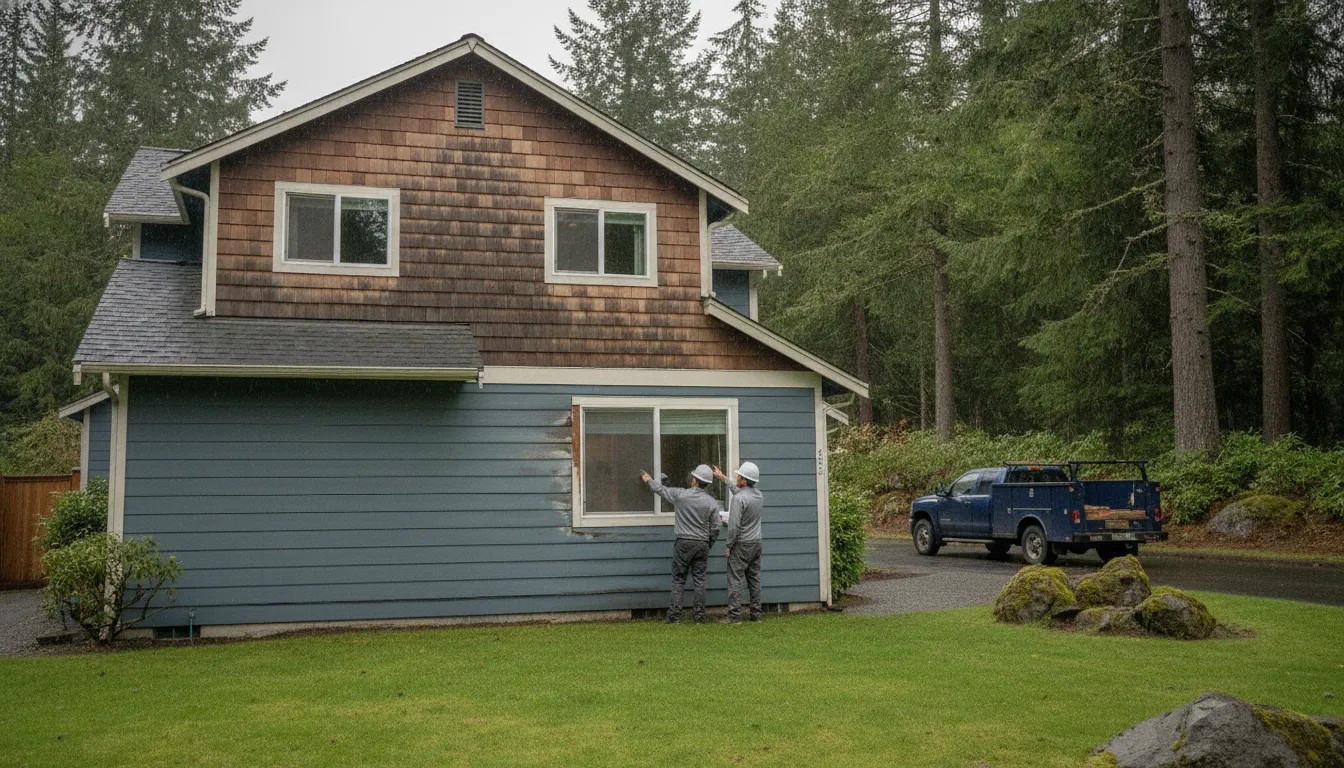
A good assessment starts with what you can see from the ground. You do not need to climb a ladder or pull a board. Photos from a dry morning, plus notes about when the stain appeared, save a second trip.
Walk each elevation and record these items:
- Cracks, holes, or open joints, including the corner where two materials meet.
- Boards that cup, buckle, or no longer sit in a straight line.
- Soft spots you can press with a thumb at the bottom course and under windows.
- Loose, slipped, or missing panels, and any piece that rattles in a breeze.
- Bubbled paint, dark streaks under a gutter, or a stain that returns after washing.
- Moss, algae, or a musty smell at a shaded north wall.
- Daylight, flaking drywall, or a damp smell inside the same wall.
Add three context shots the crew will ask about. One of the whole elevation, so the bad area has a location. One of the ground, showing whether soil, mulch, or a deck buries the bottom edge. One of the nearest gutter outlet and downspout. If a storm, a sprinkler, or a deck rebuild came just before the stain, write the month. That timeline is often more useful than a close-up of the crack.
Skip the poke test on fiber cement and on any board above the first floor. A soft cedar board at ground level is fair to note with a gentle press. Prying a panel to “see behind it” usually tears the barrier and turns a repair into a larger opening. If you want a fuller seasonal checklist, use the siding inspection checklist between visits. For stains that look wet rather than dirty, the Washington moisture-damage guide covers drying decisions this page does not repeat.
How do vinyl, cedar, and fiber cement fail differently in Kirkland?
The face of the repair depends on the cladding. The wall behind it does not. Matching the material keeps the elevation looking even. Ignoring the layer behind it is how a matched board fails again.
| Cladding on Kirkland houses. | What usually shows first. | What the repair has to check. |
|---|---|---|
| Vinyl, including CertainTeed profiles. | Cracked corners, slipped courses, and buckled runs after a hot week. | Check the locking hem, the nailing slot, and the J-channel. Confirm the panel can still move. |
| Cedar lap, shingle, or shake. | Soft bottom edges, cupping, failed caulk, and moss on shaded walls. | See how far rot goes into the sheathing. Check flashing at trim and clearance off soil. |
| Fiber cement, including James Hardie. | Cracked planks at fasteners, open butt joints, and paint cracks at cuts. | Seal cut edges and check joint flashing. Inspect the barrier before a new piece goes in. |
Vinyl fails at movement. A locked panel that cannot expand will buckle on a warm Kirkland afternoon, then crack at the corner when wind works the loose piece. A proper repair replaces the damaged panel and restores the gap the manufacturer calls for at the nailing slot. Caulk smeared over a buckle does not fix the movement, and it often seals the water in.
Cedar fails at water storage. A shaded Finn Hill wall can hold moisture in the bottom courses for weeks. Rot starts at the end grain and at nail holes. One soft board can be cut out if the sheathing behind it is still firm and the flashing above the opening still sheds water. If several courses are soft, or the barrier is gone, a patch hides the problem.
Fiber cement fails at edges and fasteners more than at the field of the plank. James Hardie products are a Portland cement, sand, and cellulose mix that does not swell the way wood does. They still crack if a plank is fastened tight at a cut, or if an unsealed cut edge stays wet. Landmark is a James Hardie Preferred Contractor and a CertainTeed 5-Star siding contractor, so repairs on those two product lines follow the manufacturer’s fastening and finish rules rather than a generic patch.
Product choice for a future full wall is a different article. Landmark’s residential siding page covers fiber cement, cedar, and vinyl as replacement options for Eastside houses. This repair guide stays on the damaged section you already have, and it does not rank one product over another.
When is a Kirkland repair enough, and when is the wall past a patch?
Repair is the right scope when the damage is local and the wall behind the cladding is still sound. Replacement is the right scope when the same failure shows up on most of an elevation, or when the barrier and sheathing can no longer dry.
Use these checks on the day of the visit:
- Map the damage. One course, one window, or one corner can be a repair. The same crack pattern on three elevations usually is not.
- Open only as far as the soft area. Firm sheathing and an intact barrier support a piece-in repair. Dark, crumbling sheathing means the scope grows before new cladding goes on.
- Trace the water. A failed kickout flashing or a buried bottom course will wreck the new piece unless that detail changes.
- Match what is left. If the profile, thickness, or factory color is discontinued, a small repair can still work with a planned transition. A whole elevation of mixed reveals rarely looks finished.
- Ask what the warranty actually covers. Landmark’s lifetime craftsmanship warranty applies to full roofing and siding replacements, transfers once within 20 years, and does not cover repairs, patchwork, or partial replacements.
That last point trips people. A careful repair can still be the right job. It is just not the same promise as a full replacement. Storm damage, skipped maintenance, and later work by another contractor also sit outside that replacement warranty. If the visit shows the wall needs a full elevation or a whole house, the local siding replacement guide picks up the planning steps. That service page is where a full Kirkland replacement is scoped.
Do not decide from age alone. A 15-year cedar wall with one rotten course at a deck is still a repair if the sheathing beside it is firm. A 15-year wall with no barrier, failed window pans, and soft sheathing at every opening is a replacement, even if the paint still looks even from the street.
What should a repair scope say about the wall assembly?
Ask for the scope in writing before anyone orders boards. A Kirkland repair proposal should name the elevation, the material, and the layers that will be opened. “Replace damaged siding” is not a scope.
Look for these lines:
- Which boards or panels come off, and how far past the visible damage the crew will open.
- Whether sheathing will be repaired or replaced, and what happens if more rot appears once the cladding is off.
- How the water-resistive barrier will be lapped back into the existing sheet, not just taped at a hole.
- Flashing at the head, sill, and sides of any opening inside the repair, plus roof-to-wall metal if the damage sits under a gutter.
- Ground clearance at the bottom course, including whether soil or a deck board has to move.
- Finish plan: factory color, field paint, or a clear note that the new piece will not match faded siding exactly.
- Site protection, daily cleanup, and who pulls any permit the city requires for the opening.
Landmark’s written proposals break out materials, labor, timeline, and warranty terms. Crews are employees, not subcontracted day labor. A supervisor stays on the job, and the site gets a magnetic sweep before the crew leaves. Standard repair requests get a response within 24 hours. The on-site look is free. Larger repairs use a 40 percent deposit at signing and the balance after completion. Bigger exterior projects can use the financing options page, including 0 percent APR plans on qualifying work.
If the scope includes a rainscreen gap or a new drainage mat, ask why. Some fiber cement details do not require an open cavity under the state code exception, as long as the barrier is there. A gap can still be the right call on a shaded, lake-facing wall that stays wet. The Washington rainscreen guide explains that choice. It should not be copied into every small patch.
How should you prepare the house for the assessment?
The visit goes faster when the wall is reachable and the history is written down. Plan on a ground-level walk of every elevation, plus a look inside at any stain you have seen on drywall.
Before the crew arrives:
- Move cars, grills, and storage bins at least a few feet off the damaged wall.
- Unlock gates to side yards. Note any dog that uses that yard.
- Trim only what blocks a photo of the bottom course. Leave roots and large shrubs for the visit so the crew can see soil height.
- Clear the downspout outlet if it dumps at the wall. Do not caulk the open joint the night before. Fresh sealant hides the clue.
- Set out prior invoices, paint codes, and any product sticker you saved from the original siding.
- If an insurer is involved, have the claim number ready. Do not start tear-off until the adjuster and the contractor agree on what gets opened.
During the walk, ask the lead to show you the likely water entry with a hand on the wall, not only on a tablet. A good Kirkland assessment names one primary path. Common ones are a window sill with reverse slope, a deck ledger with no flashing, a gutter dumping into the starter, or siding buried in bark. Secondary stains get noted. They do not all become openings.
You should leave with a recommendation that says repair, repair plus a flashing fix, or replacement of a defined area. You should also hear what the crew will not do. Landmark does not treat a repair as a full-replacement warranty job. If the honest answer is a larger project, the estimate should say so before any board comes off.
Caulk is the detail people try to solve alone. A sealed joint that was designed to drain can trap water. The siding caulking maintenance guide covers which joints to keep and which to leave alone. Use it for upkeep after a repair, not as a substitute for opening a soft wall.
What happens after you approve a Kirkland siding repair?
Once you accept the written scope, the sequence is short. Materials are ordered from the manufacturer, not pulled from a mixed leftover pile, so the profile match is deliberate. The start date is one you pick, with room for a wet week. Kirkland rain will stop a finish coat. It should not surprise the schedule.
On repair day the crew protects walks and plants, opens the marked area, and checks sheathing before new cladding goes back. If the rot runs farther than the proposal, work pauses for a change you can see, rather than a buried add-on. Fasteners, end gaps, and cut-edge sealing follow the product. James Hardie and CertainTeed details are not interchangeable with cedar.
Finish happens after the wall can take it. Field-painted cedar and fiber cement need a dry surface. Factory-finished fiber cement needs end cuts sealed so the color system still has a chance. The new piece will be cleaner than a ten-year-old wall. That is normal. Blending paint is part of the scope when the proposal says so.
At the end, a supervisor walks the elevation with you. You look at the opened area, the flashing, the ground clearance, and the cleanup. The balance is due within three days of completion on the company’s standard payment terms. Keep the invoice with the photos from the day of the repair. A later full replacement can carry the lifetime craftsmanship warranty. This repair cannot, and the paperwork should not imply that it does.
If the same stain returns the next winter, call again with the original invoice and a new photo. Recurring water means a path was missed, or a gutter, deck, or sprinkler changed. It is not a reason to add another bead of caulk and hope.
Call (855) 908-7663 and ask for a Kirkland siding repair visit.
Frequently Asked Questions
Does Kirkland require a permit for house siding repair?
Many like-for-like repairs on a single-family house do not need a building permit. A repair that opens sheathing, changes a window, or alters the wall’s structure can. Landmark pulls required permits as part of the job when the scope needs them. Ask the city before you assume a large opening is exempt, because the answer depends on how much of the wall comes off.
Can one cracked board wait until spring?
A hairline crack high on a south wall, with no inside stain, can often wait for a dry week. A soft bottom course, a leak you can see indoors, or an open hole after a storm should not wait through November rain. Same-day tarping is available for emergency calls placed before noon, and that tarping cost is credited toward the repair invoice.
Will new siding match my faded Kirkland house?
Factory colors and field paint can get close. They rarely match a wall that has faced Lake Washington weather for a decade. The proposal should say whether the repair is a piece-in match, a painted blend, or a full course replacement so the eye reads one plane. Discontinued profiles are called out before order, not after the old board is gone.
Who does the repair work on my house?
Landmark uses its own installation crews, supervised on site, rather than handing the wall to a subcontractor. The company has been in Redmond since 2005 and holds Washington license LANDMRS880BS. Siding credentials include James Hardie Preferred Contractor and CertainTeed 5-Star. Roofing badges on the Kirkland service page are separate from the siding repair scope.
Does a siding repair include the gutter or the window?
Only when the water path runs through them. A repair scope can add a downspout extension, a kickout flashing, or window flashing if those pieces are letting rain behind the cladding. It does not automatically become a window replacement or a full gutter install. Those are separate projects, quoted on their own if you want them done while the wall is open.