
Date
Mon Sep 28A missing, cracked, or lifted asphalt shingle can look like a small defect. It may expose more of the roofing system to Washington rain and wind. The visible shingle is only one part of that system. It can also include underlayment, starter components, and hip and ridge caps. A careful evaluation helps separate a limited repair from damage that needs broader attention.
Learning how to repair roof shingles starts with recognizing the safety boundary. A qualified roofing professional can address some individual shingles and fastening problems. Homeowners should inspect from the ground. Avoid climbing when access, weather, or damage extent is uncertain.
Request a roof inspection if you cannot safely confirm the damage from the ground.
The right next step depends on what caused the visible problem and whether moisture or structural concerns are present. Begin by understanding which asphalt shingle conditions may be repairable and which signs call for a professional assessment.
Can Asphalt Shingles Be Repaired?
Often, yes. Limited damage to an asphalt shingle roof may be repairable without disturbing a large section of the roof. The right answer depends on what caused the visible problem, how far moisture or deterioration has spread, and whether the surrounding roof components remain sound.
An asphalt shingle roof is a system, not just a surface layer. It includes underlayment, starter components, shingles, and hip and ridge caps. These parts work together, but many can be addressed independently. A damaged shingle may be only one part of the issue. So a visible defect should be treated as a reason to evaluate the area rather than as a complete diagnosis. The Asphalt Roofing Manufacturers Association explains the repairability of asphalt shingle systems.
Which shingle problems may be repairable?
Common repair categories include replacing a missing, damaged, or punctured shingle. They may also include addressing warped or lifted shingles, resealing wind-damaged shingles, and correcting incorrectly seated or backed-out fasteners. A qualified roofing professional can also determine whether nearby flashing, penetrations, or other components contributed to the problem.
Wind damage can make the need for repair obvious, but not every lifted or irregular shingle has the same cause. A puncture may come from windborne debris. Warping may reflect installation, age, moisture, or conditions elsewhere in the roof assembly. In some cases, an individual shingle can be separated from the sealed area so it can be repaired or replaced without opening a broad section of roofing. The repair method and materials should follow the shingle manufacturer’s instructions and applicable Washington requirements.
Why does matching matter?
A replacement should protect the roof and fit the existing installation as closely as practical. Leftover shingles from the original installation can help a contractor make a better match. If none are available, the roof’s installation year and the shingle color name may help identify a similar product. Exact visual matching can still be difficult after weather exposure, so the goal is a sound, compatible repair rather than a promise that the patch will be invisible.
| What you notice. | What it may indicate. | Safer next step. |
|---|---|---|
| One missing or punctured shingle. | A limited surface repair may be possible. | Document it from the ground and arrange an assessment. |
| Several lifted, warped, or damaged areas. | A wider roof-system concern may be present. | Do not climb. Request a professional inspection. |
| Interior staining, dripping, or wet insulation. | Water may have moved below the roof covering. | Report the moisture and ask about the full affected area. |
Homeowners in the Puget Sound area should not assume that a shingle repair is safe to handle from a ladder or roof surface. The safest next step is an evaluation. It can distinguish a limited repair from a broader roof-system concern.
What Can You Check Safely From the Ground?
A first look should stay at ground level. Do not climb onto the roof to investigate suspected shingle damage, even if the problem appears small. Wet surfaces, steep slopes, hidden structural damage, and uncertain footing can turn a quick check into a serious fall hazard.
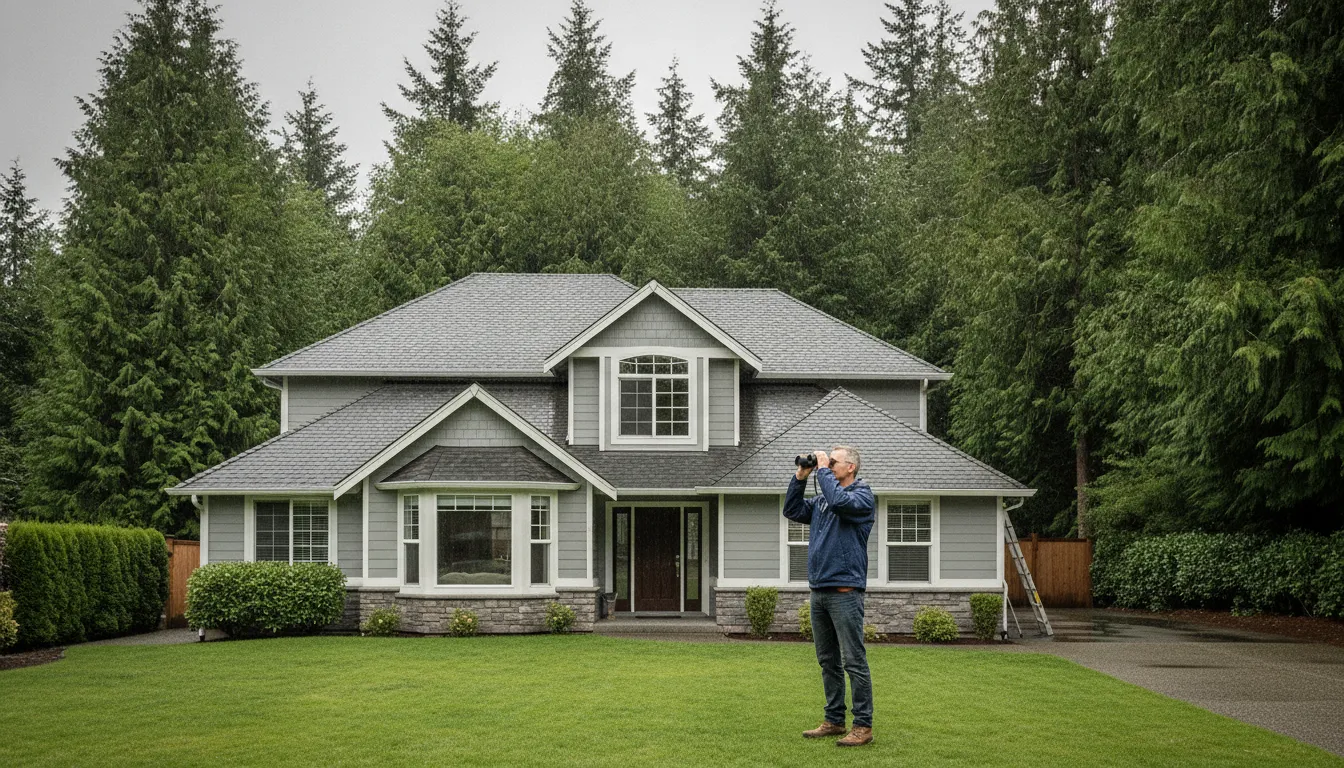
Use binoculars from the yard, driveway, or another stable location. Walk the perimeter of the house and scan the roof from several angles. Look for these visible changes:
- Obvious gaps in an otherwise consistent shingle pattern.
- Shingles that appear displaced, lifted, curled, or warped.
- Tabs that no longer lie flat or look separated from the course below.
- Dark openings, exposed underlayment, or other areas that look different after a storm.
- Unusual areas of missing granules, treated only as an observation rather than a diagnosis.
The location of visible damage also matters. A missing or displaced shingle near a valley, where two roof slopes meet, may deserve more urgent attention because that area concentrates water flow. Damage near a vent, chimney, skylight, or other roof penetration can also involve more than the shingle itself. Do not reach toward these areas or try to press a shingle back into place.
Weather can help explain when a change occurred. Compare what you see after strong wind or heavy rain with older photos, if you have them. A new gap after a storm deserves prompt attention, but the roof may still look intact from the ground while water is entering below the surface.
Check inside the home without entering a questionable attic space or disturbing wet materials. Look at ceilings and upper walls for water stains, active dripping, wet spots, or peeling and bubbling paint. If you can safely view the attic from its access point, note damp or compressed insulation, dark spots on the underside of roof decking, or visible daylight.
These signs can indicate moisture concerns. They do not identify the exact entry point, so avoid assuming that the spot directly below the exterior damage is the source.
A professional assessment can connect these observations with the condition of the shingles, flashing, drainage, penetrations, structural areas, and attic ventilation. Landmark’s professional roof inspection checks are designed to evaluate those related conditions. Record what you noticed, when you noticed it, and what weather preceded it. Then arrange an inspection rather than attempting to determine how to repair roof shingles from a ladder or rooftop.
How to Repair Roof Shingles Safely Without Climbing
For most homeowners, climbing onto a roof to repair a shingle is not a safe do-it-yourself project. A roof can look solid from the ground while its surface, edges, or underlying deck have weakened. Wet weather, moss, steep slopes, brittle shingles, and concealed rot can make a simple-looking repair more hazardous than expected.
Fall exposure is the primary concern. OSHA identifies falls as the leading cause of work-related deaths among residential construction workers. It states that workers six feet or more above a lower level need an accepted fall-protection method.
That guidance is written for trained workers and employers. It is not a signal that a homeowner can safely improvise roof access. You can review the OSHA residential fall-protection guidance for the relevant safety boundaries.
Roof condition can change the risk
Shingle damage may be evidence of a larger problem. If the roof deck has deteriorated, the surface may not support a person’s weight as expected. OSHA’s roof-repair guidance warns that fall risk increases when a roof shows signs of lost integrity or when hazards are uncertain.
The same guidance says structural integrity should be determined before work begins. It also calls for precautions that protect workers. Signs of deterioration, such as dry rot, call for evaluation by a competent person. A homeowner should not probe further.
OSHA also explains that repair workers may face extra fall risk when roof integrity is uncertain. Its roof-repair fall-safety factsheet describes why hazard evaluation matters.
Fastening is another reason not to treat a roof repair as a quick patch. Proper fastening depends on the specific shingle manufacturer’s instructions and applicable building requirements. Improperly located or driven nails can contribute to sealing failures, blow-offs, raised tabs, or buckling. A repair that appears complete can therefore leave a path for water or create a future failure.
What professional access may involve
There is no single access method that fits every roof. OSHA notes that professional repair crews may use scaffolding, aerial lifts, or other fall-protection systems. The building and repair location determine the appropriate method.
A damaged area near an edge may call for a stable elevated platform, while another location may require a different approach. The right choice follows a hazard evaluation, not a generic ladder or climbing formula.
A homeowner’s safest role is usually limited to ground-level observation and interior reporting. Note apparent missing or warped shingles, visible water intrusion, or changes after a storm without stepping onto the roof. Stop at that boundary if you are unsure about the roof’s condition, the damage location, or the access required. A qualified inspection can determine whether the issue is a limited shingle repair or a broader concern involving flashing, the deck, moisture, or ventilation.
What Does a Professional Shingle Repair Include?
A professional repair begins with determining whether the visible shingle damage is isolated or connected to another part of the roofing system. The inspection may consider the shingle surface, underlayment, flashing, roof penetrations, drainage, and the surrounding roof area. Landmark’s residential inspections also evaluate structural soundness and attic ventilation, because a missing or warped shingle is not always the full extent of the problem.
Asphalt roofing systems contain several components that work together, including underlayment, starter components, shingles, and hip and ridge caps. Many of these components can be repaired independently, which may allow a contractor to address a limited defect without disturbing a large section of the roof. The correct scope depends on what the inspection finds, not only on what is easiest to see from the ground.
Assessing the damage and matching materials
The roofer first identifies the affected components and checks whether water could be entering around the damaged area. A repair may involve replacing a missing, warped, damaged, or punctured shingle. If a shingle was lifted by wind, the work may instead focus on resealing it when the surrounding material remains suitable for repair. Where a roof junction or penetration is involved, the flashing may need attention as well. Homeowners can review roof flashing repair warning signs before an inspection.
Replacement shingles should be selected with the existing roof in mind. Leftover shingles from the original installation can make matching easier. If none are available, the roof’s installation year and the original color name can help a contractor identify a similar commercially available product. A close match supports a more consistent repair, although weathering can make an exact visual match difficult.
Fasteners, sealing, and safe access
Fasteners receive careful attention because their placement and depth affect how shingles perform. Incorrectly located or driven nails can contribute to sealing failures, blow-offs, raised tabs, or buckling. The required number of fasteners can vary by shingle and application. So a qualified roofer follows the specific manufacturer’s instructions and applicable building codes rather than relying on a universal nail pattern.
Safe access is part of the repair plan, not an afterthought. Before work begins, the contractor should account for roof condition, structural integrity, height, slope, edges, and other hazards. Depending on the location, professional crews may use scaffolding, an aerial lift, or other accepted fall-protection methods. Edge repairs, for example, may be reachable from a stable scaffold or aerial lift. These methods reduce exposure to uncertain roof conditions while allowing the affected area to be examined and repaired.
When Should You Stop Thinking About a Shingle Repair?
A missing, warped, or punctured shingle may be an isolated repair. It may also be the visible part of a larger roof problem. The right question is not only whether one shingle can be replaced, but whether the roof system beneath and around it is still protecting the home.
Look beyond the damaged shingle
A broader assessment makes sense when there are several damaged areas, repeated leaks, or signs that water has moved past the roof covering. An inspection should consider active or past leak evidence, flashing, drainage, roof penetrations, vents, structural soundness, and attic ventilation. Landmark Roofing & Siding includes these areas in its residential roof inspections, rather than treating every visible shingle as an isolated defect.
Flashing and drainage deserve particular attention. A shingle near a roof junction, penetration, or drainage path may be affected by water movement that is not obvious from the ground. For additional context, review these common causes of roof leaks before deciding that a single replacement will solve the problem.
Moisture can change the repair decision
Water that remains trapped cannot be safely covered and forgotten. Federal homeowner guidance advises against reusing material if it will not have time to dry before being covered. Wet insulation may also need to be removed so the ceiling can dry properly.
If a roof is actively leaking, the leak should be addressed before attic air sealing or insulation work proceeds. The federal roof-repair guidance for homeowners also says to choose the safest option when handling storm-damaged materials.
These conditions can point to compromised sheathing, damp insulation, or moisture in the attic rather than a surface-only shingle issue. Attic ventilation also affects moisture levels in roof sheathing and structural members. If ventilation does not meet applicable building code, the guidance recommends engaging a qualified contractor to address the needed venting.
Structural concerns require a clear safety boundary
Do not climb onto a roof to investigate soft areas, suspected rot, or uncertain damage. OSHA guidance notes that roof-repair workers can face increased fall risk when roof integrity is compromised. If damage may affect the home’s structural integrity, federal guidance recommends consulting a professional engineer and calling a professional when the situation is uncertain.
For Washington homeowners, especially after prolonged rain or a storm, a professional inspection can determine whether the next step is a limited repair or a broader roof-system evaluation. That distinction protects the home without assuming that every damaged shingle requires the same response.
How Can Washington Homeowners Prepare for an Inspection?
A little preparation can help an inspection answer the right questions without requiring you to climb onto the roof. Start by gathering any records you have about the roof, including the installation year, past repairs, and the dates of recent storms or other events that may have caused damage. Note what the weather was like when you first noticed a lifted, missing, cracked, or warped shingle. If water appeared indoors, record when you saw staining, dripping, or dampness and which rooms were affected.
Set aside leftover shingles from the original installation if you have them. Stored spare shingles can make it easier to identify a close match during a repair. If no leftovers are available, the roof’s installation year and the shingle color name can help a contractor look for a similar commercially available product. Do not move across the roof to find a sample. Keep stored materials dry and tell the inspector where they are located.
What photos and observations are useful?
Take photos from the ground or from a safe location such as a window. Capture the affected roof area, nearby gutters, visible debris, and any interior signs of water entry. Binoculars may help you observe apparent gaps or displaced shingles without walking on the roof. Avoid placing a ladder against the roof or trying to reach a damaged area for a closer image. A photo documents what you saw, but it does not confirm whether the underlayment, flashing, decking, or other parts of the roof system are affected.
Keep a short list of questions for the inspection. Ask what appears damaged, whether the issue seems limited to the shingles, and whether flashing, drainage, vents, structural soundness, or attic ventilation also need attention. You can also ask what safe access is required for a closer evaluation and what temporary steps, if any, are appropriate while the work is planned. Landmark’s residential inspections review these related conditions in addition to shingle and surface wear.
- Record the first date you noticed the change and the weather around it.
- Photograph the roof and interior signs from a safe location.
- Gather spare shingles or roof records without climbing for them.
- Ask whether the visible issue is limited or connected to another roof component.
If the damage followed high winds or another storm, share the timing and any ground-level observations with the inspector. This context can help separate a recent event from older wear. For more context on documenting and responding to storm-related problems, see our guide to storm damage roof repair. Landmark serves homeowners across Puget Sound, including King, Pierce, and Snohomish counties, so ask about inspection availability in your Washington community.
Request a roof inspection before the FAQ if you are unsure whether the damage is limited to one shingle.
Frequently Asked Questions
Can roof shingles be repaired?
Often, yes. Limited damage such as a missing, warped, punctured, or wind-lifted shingle may be repairable without disturbing a large roof area. The correct scope depends on what is underneath the visible damage, including the underlayment, flashing, fasteners, and roof decking.
How should I handle lifted roof shingles?
Do not climb onto the roof to press, nail, or seal a lifted shingle yourself. Wind can expose weaknesses that are not visible from the ground, and incorrectly placed fasteners can contribute to sealing failures, blow-offs, raised tabs, or buckling. Have a qualified roofing professional assess the area, especially after a Washington windstorm.
Can I repair my roof shingles myself?
A ground-level check with binoculars and a look for interior water staining can help you document the problem. But roof access and repair may involve fall hazards, uncertain roof integrity, and hidden moisture. If you cannot safely confirm the damage or reach it without climbing, arrange a professional inspection instead.
What do you use to glue roof shingles?
There is no universal adhesive solution for every shingle or condition. The appropriate repair may involve approved sealing materials, replacement shingles, or corrected fastening, based on the shingle manufacturer’s instructions and applicable codes. A roofing professional should determine the material and repair method rather than relying on household glue or an improvised patch.
Schedule a Roof Inspection
A careful inspection can help distinguish a limited shingle repair from damage that needs broader attention. It also gives you a safer way to evaluate concerns without climbing onto the roof yourself. Request a roof inspection through Landmark Roofing & Siding’s contact page and share what you have observed from the ground, along with any interior signs of moisture.